How judgement and safety are approached
Guidance on Ciss Outdoors is shaped by experience and situational awareness rather than fixed rules or one-size-fits-all advice. Articles are written to inform decision-making, allowing readers to weigh options and choose approaches that fit their own circumstances.
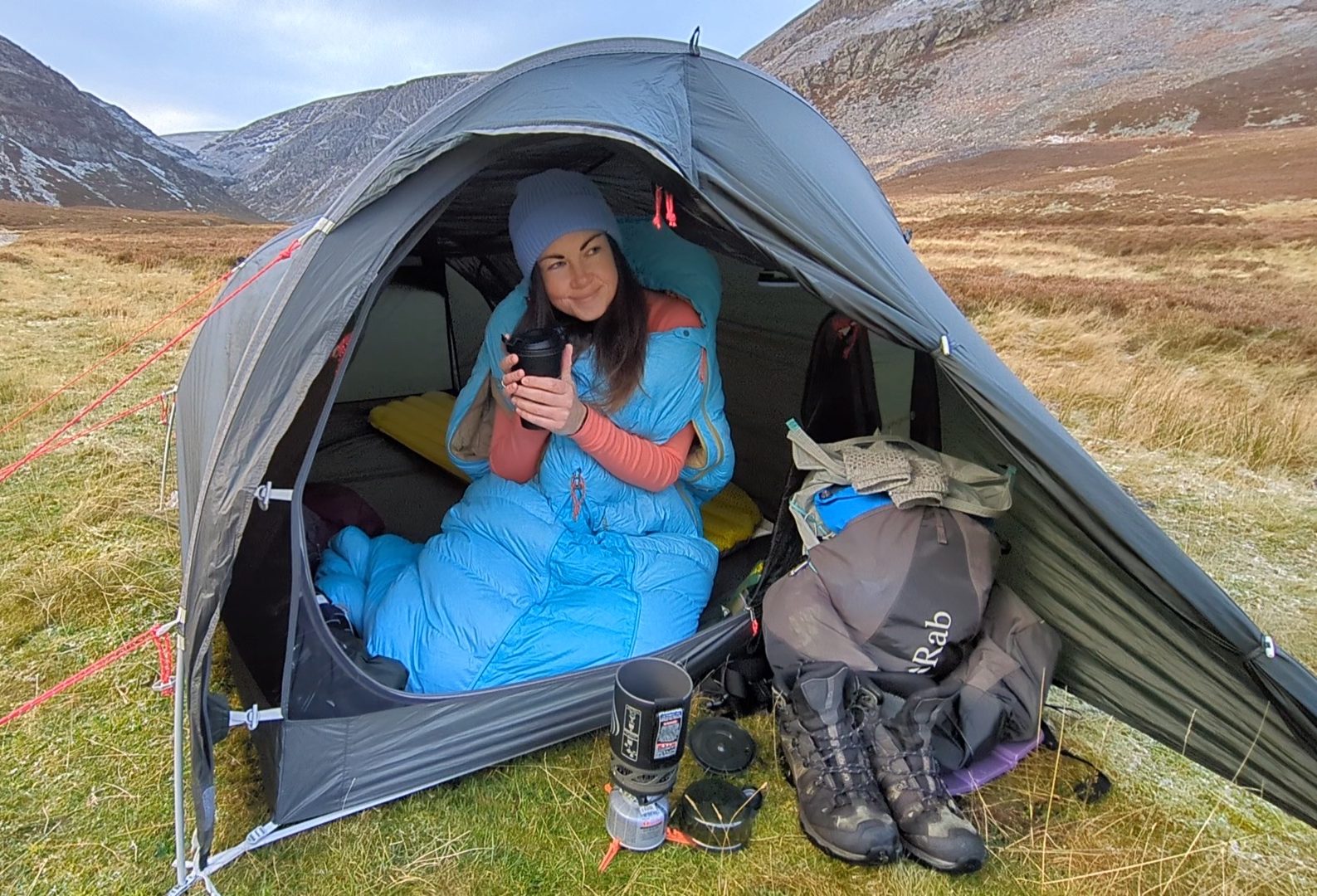
Wild camping is one of those outdoor activities where your gear naturally evolves as you gain experience. I’ve refined what I carry through cold nights, pack faff, and plenty of trial and error. The equipment listed here is what I now rely on, items I’ve used repeatedly in Scottish conditions. Each one is reliable, functional, and suited to my solo trips.
If you’re building your own wild camping setup, this breakdown covers the essentials I trust for solo camps across Scotland: pack, sleep system, shelter, stove, and safety items.
Gear List Overview
1-2 Night Wild Camping Pack:
Rab Muon 40L
Available from: Rab and other UK retailers.

The Rab Muon 40L is a fantastic pack: ultralight, comfortable, and tough enough for repeated use. Its structure keeps weight close to the spine, making long approaches and multi-day trips feel more controlled. With heavy loads, it is the most comfortable pack I’ve ever owned.
Key Features
- 40-litre internal capacity, outside storage loops
- Lightweight, but robust. Weight approx. 0.9 kg
- Roll-top closure
- Adjustable harness system
Why It Earns a Place in My Gear
It offers exactly the space I need without tempting me to overpack. Durable, simple, and proven on multiple trips.
Sleeping Bag (Warm Conditions):
Therm-a-Rest Boost 650
Available from: Rock & Run and other UK retailers.

Lightweight, compact and warm enough for spring and summer wild camping, the Boost 650 is ideal for shoulder-season nights or higher-temperature camps. While the official comfort and limit ratings (as listed in Key Features below) suggest it performs well into colder temperatures, I’ve personally found it much more suited to milder nights. In my experience, it doesn’t feel comfortable anywhere near its rating, so I now reserve it strictly for milder trips.
Key Features
- Temperature ratings: comfort 0°C, limit -6°C
- Weight for regular length version approx 1.2 kg
- 650-fill hydrophobic down
- Zippered arm hole features so you can perform tasks without getting out of the bag
- Central zip system which converts the bag from rectangular to mummy
Why It Earns a Place in My Gear
Good warmth-to-weight for milder conditions. When a winter bag is overkill, this keeps my pack light and my nights comfortable.
Sleeping Bag (Cold Conditions):
OEX Leviathan EV 900
Available from: GO Outdoors and other UK retailers.

Scottish nights can go from chilly to brutal quickly. The Leviathan retains warmth, has a water-repellent coating, and has seen me through everything from winter bothy nights to frosty tent mornings.
Key Features
- Temperature ratings: comfort -9°C, limit -16°C
- Weight approx 1.34 kg
- 900 g of 600-fill ethically sourced down
- Hydrophobic treatment
Why It Earns a Place in My Gear
When temperatures drop, this is the bag I trust. Designed for 4-season UK conditions, it offers reliable warmth.
Sleep Mat:
Rab Ionosphere 5
Available from: Rab and other UK retailers.

I prefer a sleep mat that prioritises insulation and comfort without adding too much unnecessary weight, and I only use one mat year-round. The Rab Ionosphere 5 is warmer than I technically need for summer camps, but good mats are investment pieces, and I’ve yet to justify buying a second one.
Key Features
- Weight approx 550g
- Patching kit, stuff sack, and inflation bag all included
- Durable material and good build quality
- 4.8 R-value
- Packs to 23 × 11 cm
Why It Earns a Place in My Gear
Comfort + warmth = good sleep. This mat balances both beautifully. I happily trade how much it weighs for protection against unexpected cold snaps.
Tent (Low Weight):
MSR Hubba Hubba LT 2-person
Available from: Blacks and other UK retailers.

The Hubba Hubba LT feels noticeably more spacious than I’d expect from a lightweight backpacking tent. The airy design and excellent ventilation make it particularly comfortable in warmer weather, while the low pack weight means I can carry less without feeling like I’m compromising once I’m at camp.
Key Features
- Weight approx 1.54 kg
- Pack size: 51 × 14 x 13 cm
- Hydrostatic Head ratings: 1200 mm fly / 1800 mm floor
- Inner pitched first, freestanding
- dual-sided porches, symmetrical domed shape
Why It Earns a Place in My Gear
Low pack weight without sacrificing comfort. My first choice when the forecast is favourable.
Tent (Weather Protection):
Robens Sprinter 2-person
Available from: Outdoor Action and other UK retailers.

Versatile and surprisingly spacious, the Sprinter 2 has been a workhorse for me. It is not the lightest tent on the market, but it offers excellent protection against the elements. I was hesitant about the tunnel shape at first, but I have ended up loving the end-to-end headroom it provides.
Key Features
- Weight approx 1.9 kg
- Pack size: 43 × 16 x 16 cm
- Hydrostatic Head ratings: 2000 mm fly / 5000 mm floor
- Inner & flysheet can be pitched together
- Generous porch, internal space & headroom
Why It Earns a Place in My Gear
Reliable protection for more challenging weather. I particularly like the HH ratings, and large porch for cooking and storing wet kit.
Stove:
Jetboil MicroMo
Available from: Jetboil and other UK retailers.

A complete and efficient cooking system, the MicroMo suits my solo trips perfectly. As a personal preference, I never use my Jetboil for anything other than water. It is possible, though, to make meals in the pot if you are looking for that feature. I also have a small MSR Pocket Rocket 2 stove, which I sometimes use with a titanium kettle, but I prefer the MicroMo when I have enough space in my rucksack.
Key Features
- Weight approx 340 g
- 800 ml max capacity
- Rapid boil time
- Simmer control
- Packs away neatly into the pot (including fuel if you use the smallest size).
Why It Earns a Place in My Gear
Sturdy build quality and consistent performance. Boiling 800 mls of water at a time is plenty for one person.
Safety:
Garmin inReach Mini 2
Available from: Garmin UK and other UK retailers.

When solo wild camping, a communication and SOS device feels like a non-negotiable for me. I carry the Garmin inReach Mini 2 for emergencies only, but you can also perform 2-way messaging and location sharing with it. It requires a monthly subscription.
Key Features
- 100 g
- Global satellite coverage
- Battery life: up to 4 days with moderate tree cover
- IPX7 waterproof rating
Why It Earns a Place in My Gear
Peace of mind without needing phone signal, with minimal additional weight.
Small Essentials
Everyone has slightly different ideas of what counts as an “essential”, but there are small pieces of gear that make wild camping safer, more responsible, and more comfortable. These aren’t big-ticket items, but they’re things I always carry and wouldn’t want to be without.
Items to Consider When Packing:
- Head torch – for early starts, late finishes, and tent admin in the dark
- Walking poles – added stability on steep ground and long approaches
- Power bank + charging cable – great for phones, GPS devices, or head torches
- Leave No Trace toileting system – e.g., pee cloth, toilet paper, trowel, bags
- First-aid basics – blister plasters, tape, pain relief
- Emergency heat-reflective bag – lightweight backup insulation
- Water filtering system – when natural sources are available
- Navigation back-ups – map, compass, and a downloaded GPX
- Dry bags – to keep clothing, sleeping gear, and electronics protected
- Extra layers – easy to get colder than you expect once you’re camped up
- Spare hat, socks, and gloves – small items that may get wet during the day
- Lighter or waterproof matches – even if your stove has an igniter
Building Confidence Whilst Wild Camping
Wild camping is one of those experiences where your confidence grows with every night spent outside. The more you refine your setup, the more freedom you gain. My setup isn’t about chasing ultralight numbers or collecting gear; it’s about carrying equipment I know will look after me when I’m miles from the nearest road.
If you’re starting to explore wild camping on your own, or you’re working on building more comfort and self-trust in remote places, you may also find Solo Wild Camping: Confidence, Comfort, and Safety in the Outdoors helpful. It covers the practical and psychological parts of heading out alone. Things that can matter just as much as the gear itself.
Once you have equipment you trust and a rhythm that feels natural to you, everything else opens up. The quiet, the remoteness, the slow steps into the landscape, that’s the real reward. The gear simply helps get you there.
Ciss Outdoors sends out an email once a week with links to all new articles.
If you’d like to receive the Weekly Dispatch, enter your email address below.
Related reading:
Wild Camping Gear: How to Choose A Tent That Works for You
MSR Hubba Hubba LT 2-Person Tent Review: Lightweight Without Compromising Comfort


Leave a Reply