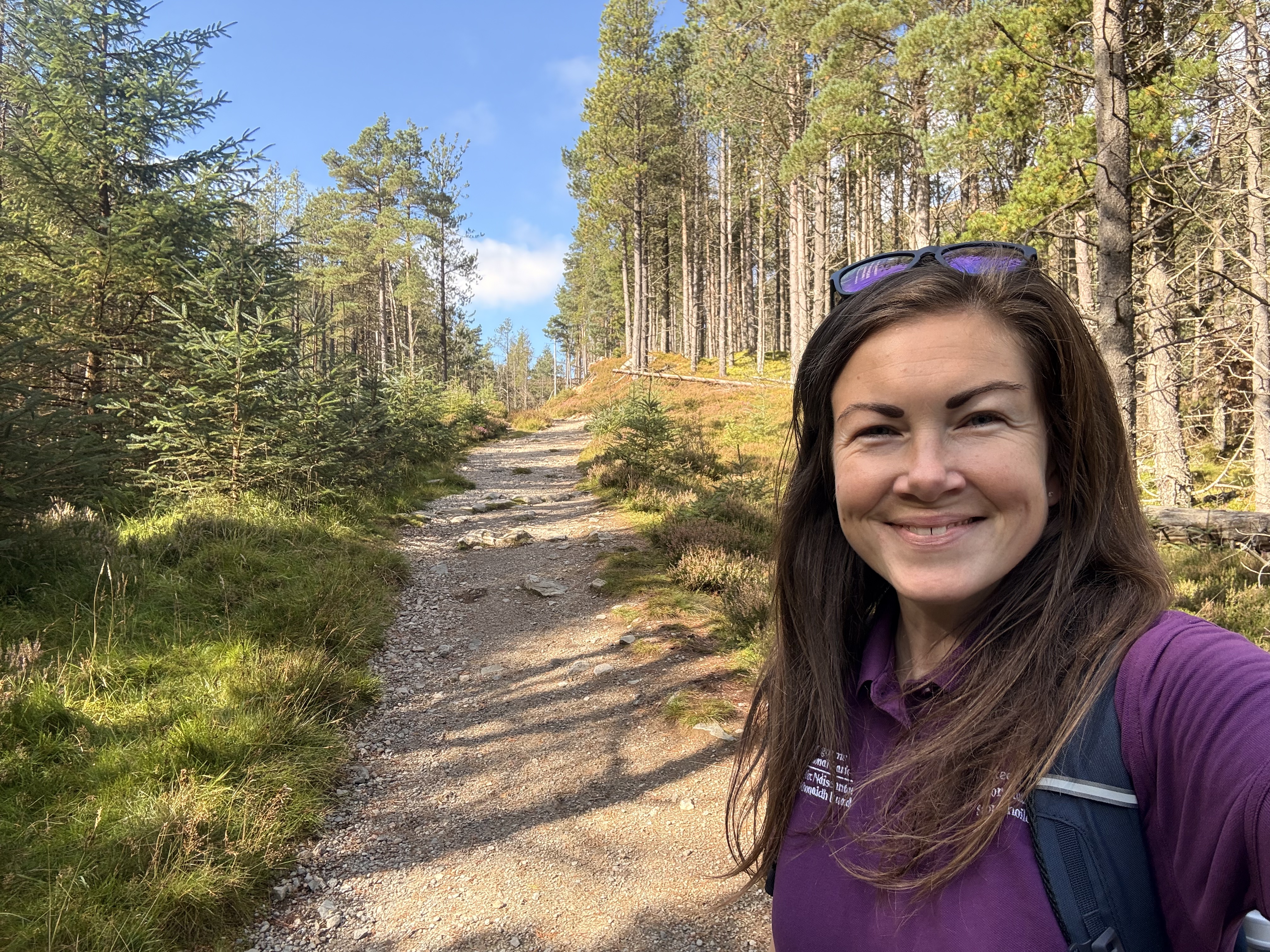
This article is based on my first-hand experience as a Volunteer Ranger with the Cairngorms National Park Authority and is not an official CNPA communication.
Recently, my parents were out in the Cairngorms when they spotted someone wearing Cairngorms National Park Authority uniform who they thought might be a Volunteer Ranger. They hadn’t stopped to speak to them because they didn’t want to bother them.
My response was that I could almost guarantee they would have been happy to talk.
I volunteer with the Cairngorms National Park Authority, and speaking to visitors is an important part of what we Volunteer Rangers do. Yet I can understand the hesitation. It isn’t always obvious who we are, and someone wearing a uniform, carrying binoculars or standing with a clipboard can quite reasonably look as though they’re busy. If you’ve ever wondered whether you should approach a Volunteer Ranger, though, you don’t need an important question or a particular reason to do it.
What Happens When You Meet a Volunteer Ranger?
Even in uniform, it isn’t necessarily obvious that you’ve encountered a Volunteer Ranger. A rucksack might cover some of the branding on a jacket, while the layers we’re wearing change with the weather. Sometimes it’s what we’re doing that attracts attention instead. I’ve had people stop to thank me while I’ve been litter picking, and binoculars or a scope will often prompt someone to ask what I’m looking at.
Volunteer Rangers take part in a range of activities while out in the National Park. I’ve been involved in water vole and raptor monitoring, as well as Flower-Insect Timed Counts, path maintenance and tree planting, so there are times when I will be carrying out an activity. If you’re curious about what we’re doing, asking isn’t an interruption.

More often, I’m the one who starts the conversation. It can be as simple as asking someone how their day is going or where they’re heading. If they have a dog, there might be useful information about keeping it under close control in particular places. If they’re hiking, I’ll often ask about their plans for the day. Sometimes the interaction is even simpler than that – we’re very happy to take your photo at a viewpoint.
How far the conversation goes depends entirely on the person. Some people are outdoors because they want time to themselves, and there’s no expectation that everyone should stop for a chat. For those who do want to talk, it can be no more than the kind of friendly exchange you might have with anyone else you meet while out walking.
We Can Share Useful Information
Sometimes a quick chat develops into something more useful. What that looks like will depend partly on the Volunteer Ranger you happen to meet. We all bring different interests, experience and areas of knowledge to the role, as well as getting to know the places where we patrol.
I’m a hiker, so at Glen Doll I regularly find myself talking to fellow hikers about routes, timings and terrain. If someone is heading up the local Munros, I’ll usually have checked the mountain weather forecast before my patrol, so I can draw their attention to conditions they might encounter, particularly if they’re unfamiliar with the area.
Local changes are another good example. Forestry operations at Glen Doll have resulted in a route diversion, and I’ve spoken to walkers to make sure they’re aware of it and understand what the alternative route involves. A sign can tell you that a diversion exists, but a conversation can give you a better idea of what that means in terms of terrain or conditions underfoot.


Volunteer Rangers won’t have the answer to everything, and part of the role is knowing where to direct people for more information. That might mean pointing someone towards a leaflet they can pick up at a Visitor Centre or another appropriate source where they can find more detailed or specialist advice.
The information can flow the other way as well. Visitors cover far more ground collectively than any Volunteer Ranger could, so conversations can alert us to litter, path conditions, potential hazards, wildlife sightings or other things happening in the area.
That information doesn’t necessarily end with the conversation. After a patrol, Volunteer Rangers submit a report, and relevant issues or observations raised by visitors can be included. Speaking to a Ranger doesn’t mean something will automatically be actioned, but it provides a way for useful information from visitors to be fed back. This can be particularly valuable when several people independently raise the same topic and a recurring picture begins to emerge.
Why I Enjoy Talking to Visitors
For me, one of the best parts of these conversations is that they don’t have to achieve anything in particular. I particularly like meeting people who are visiting the Cairngorms National Park for the first time. When you spend a lot of time somewhere, familiarity inevitably changes how you see it. Talking to somebody experiencing a place such as Corrie Fee for the first time can make you notice it through fresh eyes again.
At the other end of the spectrum are the familiar faces. When you regularly patrol the same area, you start to recognise local people and others you cross paths with more than once. Those small interactions add to the sense of being part of a community around a place.
I’ve also learned plenty from visitors. The people I meet bring their own knowledge, experiences and observations. Very few of my interactions on patrol have been anything other than enjoyable conversations between people with at least one thing in common: we’ve all chosen to spend our day out in the Cairngorms.
If You See Us, Say Hello

So if you see a Volunteer Ranger while you’re out in the Cairngorms National Park, there’s no need to worry that you’re bothering us by coming over to say hello. You might have a question, be curious about what we’re doing or simply fancy a chat while our paths cross.
And if you’d rather keep walking and enjoy some time to yourself, that’s equally fine. The point isn’t that visitors should talk to Volunteer Rangers. It’s simply that, if you’d like to, you can.
Related reading:
Why I Became a Cairngorms National Park Volunteer Ranger
Joining A Cairngorms Connect Willow Walk To Loch A’an: Carrying Saplings Into a Recovering Landscape

Leave a Reply