Ciss Outdoors is an independent outdoor and travel publication exploring places through time spent outside. Writing draws on personal experience and regional familiarity, with an emphasis on practical judgement.
Some conservation work only really comes to life when you see it happening. A willow walk is one of those things. It involves covering ground on foot, carrying bundles of saplings into remote upland areas, and placing them carefully into landscapes where woodland and scrub once existed, and where they may exist again in the future.
In June 2025, I joined a Cairngorms Connect willow walk to the basin around Loch A’an, as part of my role as a Cairngorms National Park volunteer ranger. This article looks at what a willow walk involves, why this work is taking place, and what it feels like to be part of it on the ground.
Why Willow Is Being Restored Here
Large areas of the Cairngorms once supported a broader mix of native woodland and upland scrub than we see today. In high, exposed locations like the basin around Loch A’an, that included montane scrub, a rare habitat that sits between lower woodland and the open plateau.
According to long-term habitat restoration work led by Cairngorms Connect,
montane scrub is now one of the most reduced and fragmented habitats in the Cairngorms. Willow species such as downy willow are a key part of this habitat. They help create shelter, stabilise soils, and support insects and birds adapted to upland conditions.

Surveys in the Loch A’an basin found that surviving willow plants were few in number and widely spaced, often confined to rocky ledges. In that state, they were unlikely to recover through natural regeneration alone. Restoring a broader mix of plants helps increase genetic diversity and resilience over time, which is why intervention is part of this work.
This kind of restoration exists alongside wider debates about land use and how upland landscapes are managed over the long term. One part of that wider context includes grazing pressure, particularly in areas where natural regeneration alone is no longer sufficient, as outlined in NatureScot’s guidance on grazing in upland and moorland habitats.
The Role Of The Cairngorms Connect Tree Nursery
The downy birch and downy willow we carried that day came from the Cairngorms Connect Tree Nursery, based at RSPB Scotland’s Abernethy Reserve.
The nursery focuses on growing native trees from seed and cuttings collected within the Cairngorms Connect area, ensuring the plants are suited to local conditions rather than relying on generic stock. This work supports restoration in places where natural regeneration is unlikely to happen without help. You can read more about how native trees are grown specifically for restoration in the Cairngorms.
By the time a sapling is ready to be carried into the hills, it already represents years of work, from collection and propagation through to careful growing and preparation.
How The Willow Walk Worked
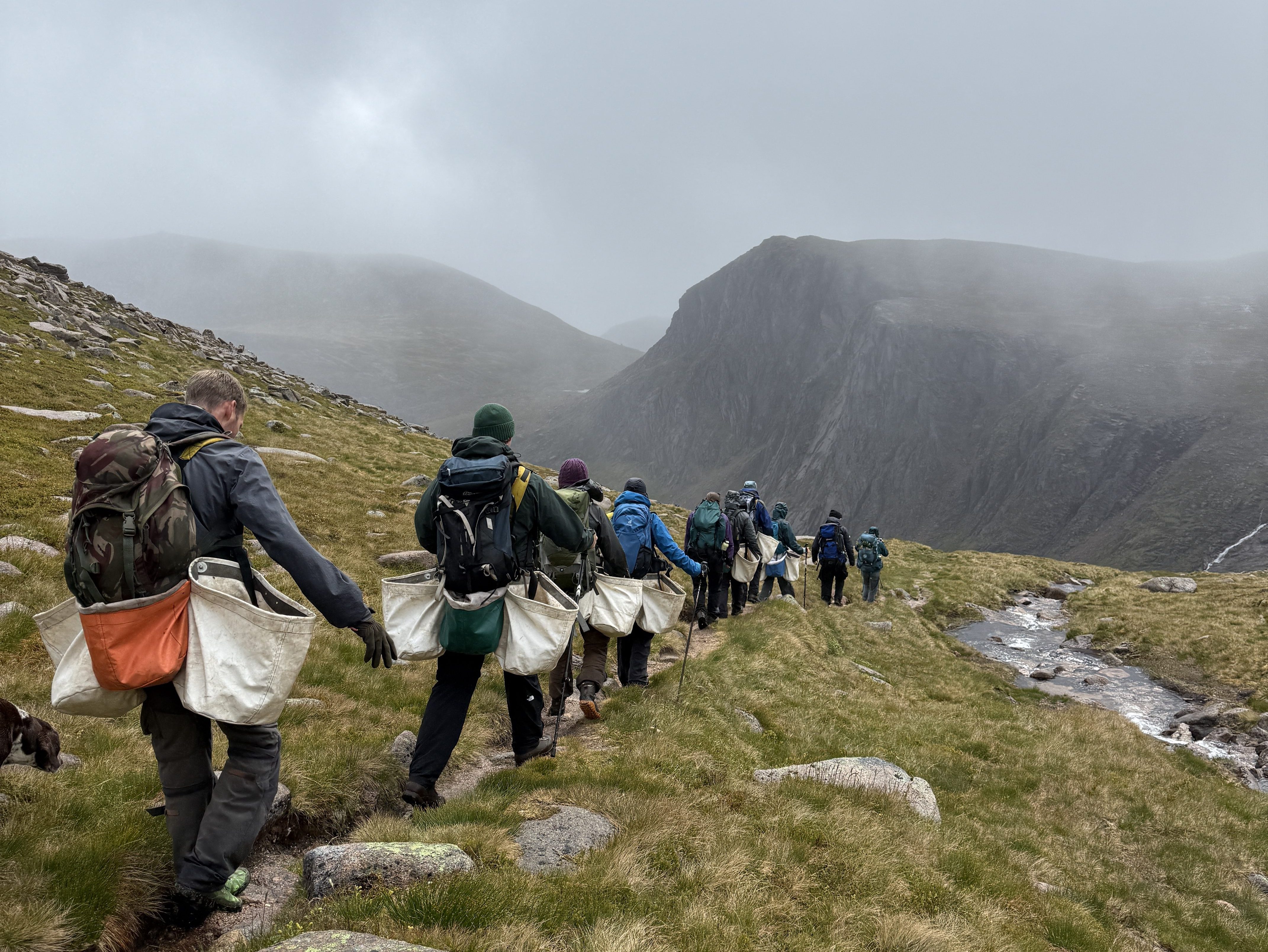
The event took place in mid-June. Conditions were of a ‘Scottish summer’ variety, rather than kind: cold drizzle, shifting visibility, and wet stone underfoot through much of the morning.
We met at the Cairngorm Mountain car park for a briefing from the walk team, covering the plan for the day and safety considerations. The group included Cairngorms Connect staff, Cairngorms National Park volunteer rangers, and members of the public. There was a noticeable emphasis on choice and pacing from the outset. People were encouraged to carry only what felt manageable.


Saplings were collected higher up the ski area from a trailer, after an initial hike without weight. From there, we continued towards the plateau, taking on bundles of downy birch and downy willow. Some used large rucksacks, others tree-carrying harnesses. The load varied widely, and that flexibility mattered.
The physical challenge was not just the ascent. The descent into the Loch A’an basin with extra weight required concentration, particularly with wet rock underfoot. The group was well supported, with a qualified mountain leader overseeing progress and staff spaced throughout to make sure no one was rushed or left behind.
As volunteer rangers, our role sat somewhere between participant and support. We carried trees, but we also talked with people, checked in, and helped keep the buoyant morale going.
At Loch A’an
Loch A’an sits high on the Cairngorm plateau, close to the upper limit of where trees can grow at all. It marks a transition zone between woodland, montane scrub, and the open plateau, which is one reason it has become a focus for restoration work.
Cairngorms Connect describes this basin as a key location for restoring rare upland habitats in the Cairngorms.
Once we reached the loch and dropped off the saplings, the Cairngorms Connect team talked through what had already been planted in the area, what was planned next, and how this site fits into wider restoration work across the Cairngorms.
We stopped for lunch overlooking the loch, and each volunteer had the opportunity to plant a sapling themselves, connecting the effort of the walk to the longer process of habitat recovery.


Working Together
One of the strongest aspects of the day was the shared camaraderie. Roles and backgrounds were secondary to the task itself. People carried what they could, talked openly about the effort involved, and learned from one another along the way.
On the climb back out of the basin, the effort from the ascent was balanced by much lighter packs. The hardest physical work was done; what remained was a stunning hike back.

What I Took Away
What I took away most strongly was the timescale. This work is built on people committing years of their working lives to outcomes they may never personally see. Being part of that, even briefly, changes how you look at the landscape.
Loch A’an is one of my favourite places in Scotland. Spending a day there contributing to its future, rather than just moving through it, felt like a privilege. I give my time as a volunteer ranger, but days like this consistently give far more back in learning, perspective, and connection than they take.
Ciss Outdoors sends out an email once a week with links to all new articles.
If you’d like to receive the Weekly Dispatch, enter your email address below.
Related reading:
Why I Became a Cairngorms National Park Volunteer Ranger
How to Make Outdoor Friends: Practical Ways to Build Confidence and Connection

Leave a Reply